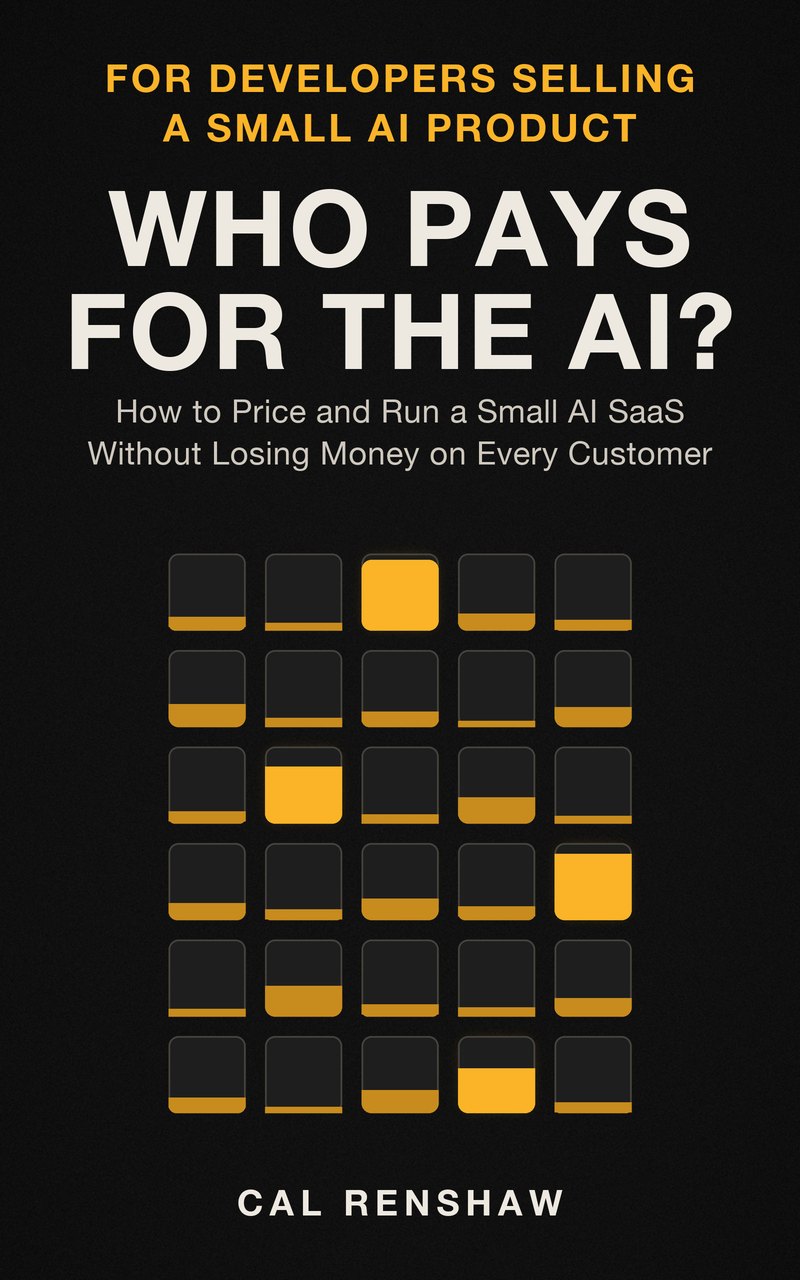
For developers selling a small AI product
Who Pays for the AI?
How to Price and Run a Small AI SaaS Without Losing Money on Every Customer
The bill: pricing and running a product with a model inside it, so every customer costs less than they pay.
Not yet published
About the book
A product with a model inside it has 2 invoices. This book is about the one you receive.
Every AI SaaS has a meter running behind it. Each customer who presses the button sends you a bill from the company whose model does the work, and the customers who love your product most send the biggest bills. Who Pays for the AI? is a practical book on pricing and running a small AI product as a one person business, so that every customer costs you less than they pay.
How it fits the series
Ship Alone gives the bill one chapter; this book is the rest of it. Read it before you add a model to a product, or the month the bill surprises you. Nobody Bought It has the holiday lets product whose bill this book grew from.
Who it's for
Developers and solo founders building or running a small AI app, AI SaaS or AI agents for small business customers, on their own, or a feature added because it demoed well. You can build it, or direct a machine to. What you do not know is whether each customer you win makes you money, and you would like to find out before the month-end bill tells you.
What's inside
- The 10-minute sum to do before you build any AI feature, and the ceiling Cal keeps model fees under
- Why your heaviest customer, not your average one, sets the price
- Flat, metered or allowance: 3 SaaS pricing models compared on one chart
- 5 ways to make the same work cost less: code first, the cheap model test, queues, retries and a daily ceiling
- What a wrong answer really costs, and which decisions never go to the model
- What to keep ready for the day a provider retires your model or changes its price
- A cost sheet and every rule on one page, in 2 appendices
The meter is fine. It is only dangerous when nobody reads it.
Questions readers ask
- How do I price an AI SaaS product?
- Start from what one unit of work costs, measured on 30 real inputs, multiplied by your heaviest sensible customer's month. Chapter 2 walks through the sum, and chapter 4 turns it into a price shape.
- Will it go out of date when model prices change?
- No provider prices appear in it. The charts are worked examples with made-up figures, so the method holds whatever the models cost when you read it.
- Is this a book about building your first AI app?
- It assumes you can build. It covers the money side every build guide skips: pricing, running costs, caps, retries, and what to do when the model is wrong.
- Is it a SaaS pricing strategy book?
- Partly. 3 of its chapters are pricing strategy for products whose costs grow with use, including how to raise a price without losing the customers who trust you.
- What if my AI feature loses money?
- The last chapter gives the number at which a feature has to justify itself, the 3 questions to ask, and how to switch it off well.
- Do I need a free tier?
- Chapter 5 argues against one on anything with a meter, and gives 4 cheaper ways to let people try the real thing.
- How do I stop a surprise bill?
- Chapter 1 opens with one, a free page found by a script at 2am, and sets out the 3 locks Cal now puts in front of every model call.
- Is it a startup playbook for funded companies?
- No. It is for bootstrapped products run by one person, where the margin on each customer decides whether the product lives.
- Does it cover AI product management?
- The parts a solo builder needs: which work a model should do, which decisions stay yours, and the weekly page that shows what each customer costs.
- Do I need to read Ship Alone first?
- No. It is the third book by the same author and stands on its own.
- How long is it?
- About 100 pages: 16 short chapters, a figure in each, and 2 appendices.
- How does Who Pays for the AI? fit with the other books in Ship Alone?
- Ship Alone gives the bill one chapter; this book is the rest of it. Read it before you add a model to a product, or the month the bill surprises you. Nobody Bought It has the holiday lets product whose bill this book grew from.
From the end of every chapter
The 15 rules in this book
- Nothing free should call a model, and every key that does needs a hard cap you've watched fire.
- Do the sum on 30 real inputs before you build, and keep the heaviest sensible customer's model fees under a tenth of their price.
- Read what each customer costs every week, and open the account before you act: keen gets a better price, broken gets a fix.
- Put an allowance on anything with a meter, set at the heaviest sensible month, with a charge above it that pays.
- Offer no free tier on anything with a meter; show saved examples, run a sample by hand, or promise the money back instead.