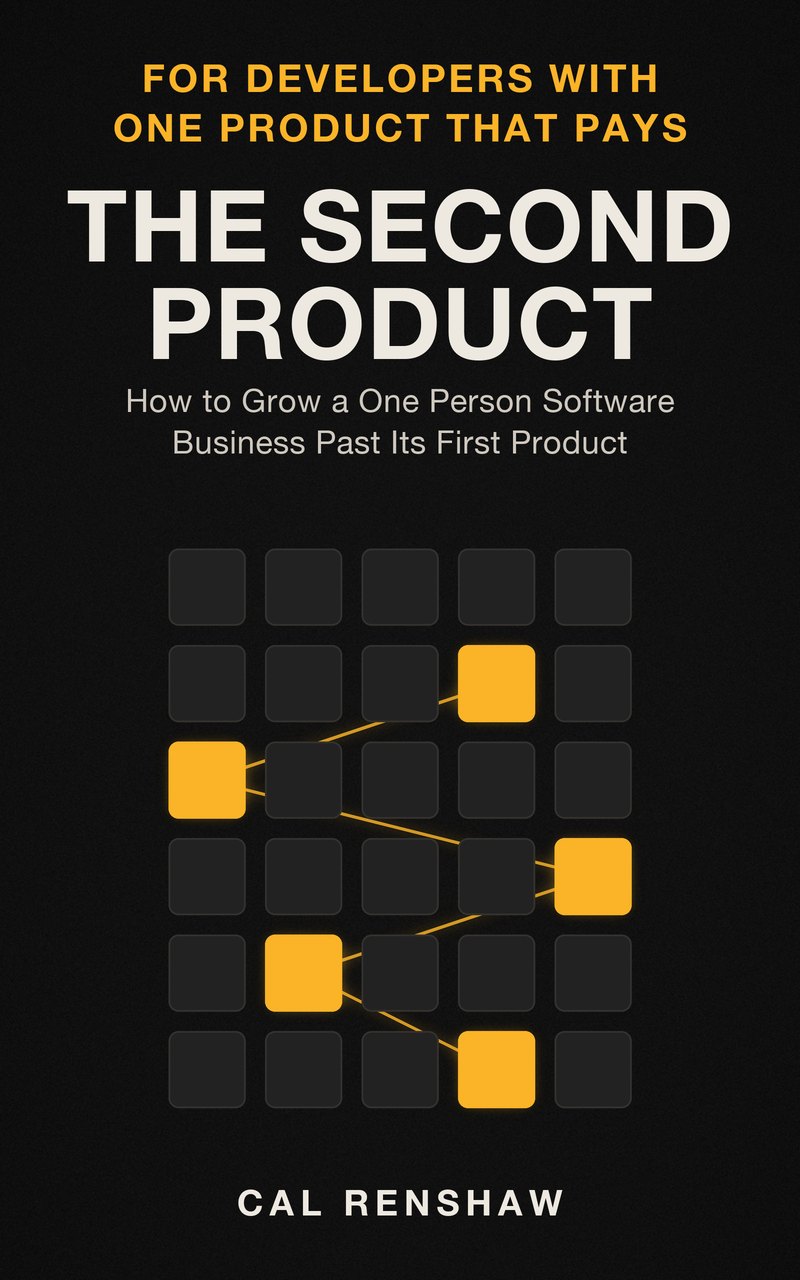
For developers with one product that pays
The Second Product
How to Grow a One Person Software Business Past Its First Product
What comes next: growing past the first product without running out of evenings.
Not yet published
About the book
The first product that pays feels like the end of something. It is the start of a different problem.
Do you build another one, grow this one, buy somebody else's, or close the one that has been dragging for a year? The Second Product is a short, practical book about growing a one person business past its first small software product, from a developer who got most of those decisions wrong first and now runs 5 paying products in about 3 evenings a week.
How it fits the series
Ship Alone gets you to one product that pays. This book is what comes after: when to start the next, where it comes from, and when to grow, hand over or close.
Who it's for
Indie hackers, solopreneurs and developers with one micro SaaS business or small tool that pays, or nearly does, wondering what comes next. Bootstrapped, no team, no funding, and no wish for either. If you want multiple streams of income from software without turning your evenings into a second job, this is the planning half of that.
What's inside
- When to start a second product, and why launching it into the first one's busiest months kills it
- The weekly slots that let 5 products fit alongside a life, and the rule that fires when one is skipped
- Where the next product comes from: cancellation replies, closing emails and the parts a dead product leaves behind
- When to grow the first product instead of starting another
- 6 checks before you buy somebody else's small product
- Handing over a working product you no longer care about, instead of closing it
- One of everything: the shared machinery that keeps several products from costing several times the work
- The one-page January review, and every rule in the book on a single page
A free evening isn't a wasted one.
Questions readers ask
- When should I start my second product?
- When the first has settled: it fits a named weekly slot, has not needed you outside that slot for a month, and its questions have become repeats. Chapter 1.
- Where do good second product ideas come from?
- Mostly from the first one: requests from paying customers, the replies people send when they cancel, and whoever answers a closing email. Chapters 4 to 7.
- Is this an indie hacker book about building?
- No. It assumes you can build. It is about what to do once one thing works: what to build next, what to keep, and what to let go.
- How many products can one person run?
- As many as fit into named slots in the week you actually have. Chapter 3 shows how to count them, and chapter 17 explains why 5 is enough for the author.
- Is product portfolio management relevant to a small business?
- Yes, at a much smaller scale. The book's version is one page, once a year, with one word next to each product: keep, grow, hand over or close.
- Should I buy an existing micro SaaS instead of building?
- Chapter 8 tells the story of a small tool the author did not buy, and the 6 checks that came out of it.
- What if my first product is working but I am bored of it?
- Chapter 9: hand it to somebody who cares about its customers more than you do, and how to do that properly.
- Is this for a bootstrapped startup with staff?
- No. It is for one person. Hiring, funding and teams are outside it.
- Do I need the earlier solopreneur books in the series?
- No. It stands on its own. Ship Alone is the method for the first product; this book is about the second.
- How long is it?
- About 90 pages: 17 short chapters, a figure in each, and 2 appendices. An evening's read, and a page to fill in every January after it.
- How does The Second Product fit with the other books in Ship Alone?
- Ship Alone gets you to one product that pays. This book is what comes after: when to start the next, where it comes from, and when to grow, hand over or close.
From the end of every chapter
The 16 rules in this book
- Start no second product until the newest paying one has settled into a named slot it fits.
- Judge each product by what it leaves behind, the list, the loop, the room and the autopsy, as well as by whether it lived.
- Every product gets a named slot, a new one needs a free slot, and 3 skipped slots in a row means it wins its slot back or goes.
- Read cancellation replies in one sitting for the sentence that goes past the question; the same paragraph from 3 strangers is a product.
- Close a product properly, with the reason, the date, the refund and a tested export, then add one line at the end for anyone curious.