Why small software products die
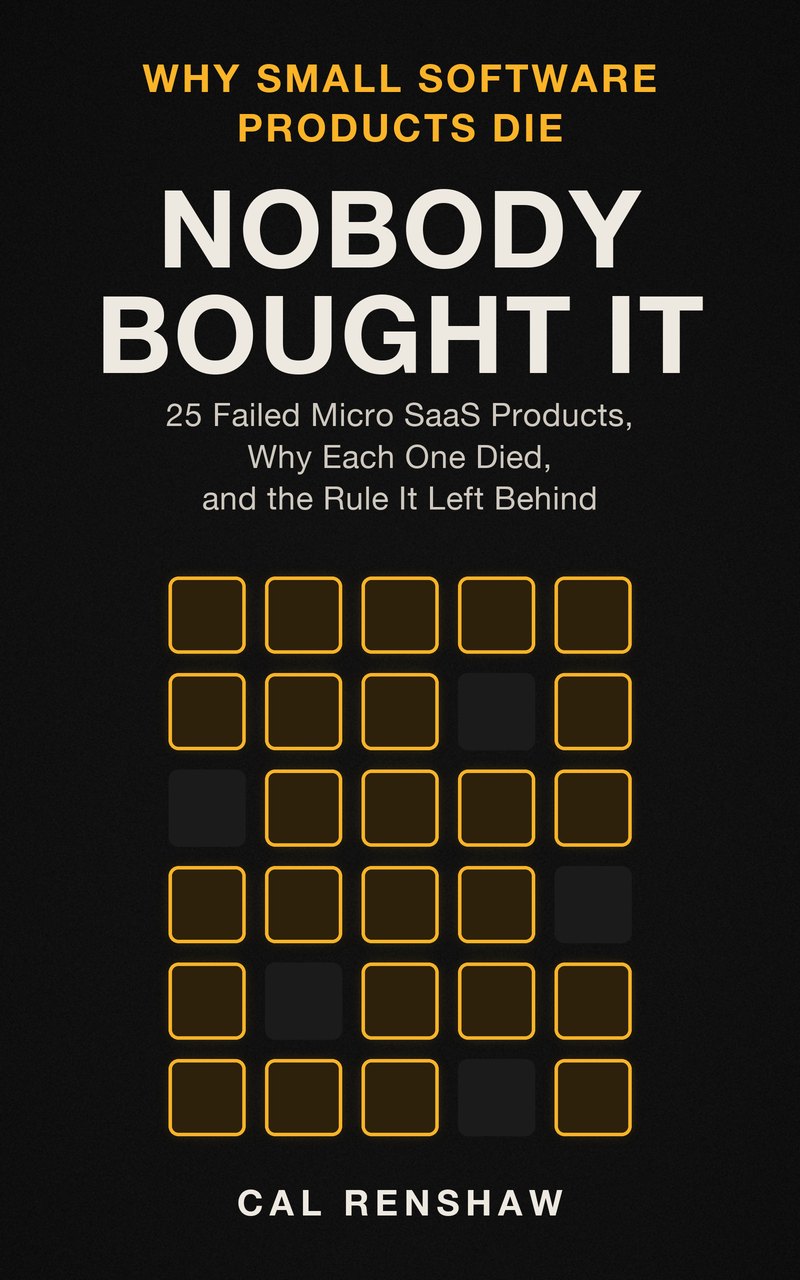
Nobody Bought It
25 Failed Micro SaaS Products, Why Each One Died, and the Rule It Left Behind
The evidence: 25 dead products, one chapter each, and the rule each death left behind.
Not yet published
About the book
25 small software products. 25 funerals. One folder of notes, written the week each one died.
Most books about why startups fail study companies with investors and staff. This one is about the kind of product one person builds in a spare room: a micro SaaS business with a handful of customers, or none. Cal Renshaw built roughly 30 of them in 9 years. 25 are dead. Nobody Bought It opens his file on every one, with the embarrassing parts left in.
How it fits the series
Nobody Bought It is the graveyard Ship Alone's method came out of. Read it before you build, or the week your current product goes quiet. Who Pays for the AI? and The Second Product take the two problems that arrive once something works.
Who it's for
Developers, indie hackers and solopreneurs building a small software product on their own, especially the ones who can build anything and have never sold it. Read it before you build the next one, or the week your current one goes quiet. It is also for anyone running a one person business with a folder of abandoned side projects and a feeling that the same thing keeps happening.
What's inside
- 25 case studies, one per chapter: what the product was, who it was for, how long it took to build and how long it lived
- A life-line chart for every product, from launch day to the evening it was switched off
- The same autopsy card at the end of each chapter, so one death can be read against another
- The rule each death left behind, and the evidence that would make him drop it
- The seven filters he now runs before building anything, and which ones each product failed
- A blank autopsy card in Appendix A, for your own graveyard
A dead product you wrote down is research. A dead product you buried is only a loss.
Questions readers ask
- Why do startups fail when the product works?
- In this book, mostly because nobody knew the product existed, or somebody knew and did not want it enough to pay. 23 of the 25 died for one of those 2 reasons. The other 2 were working when he switched them off, and Part V says why.
- Is this about venture-backed startups?
- No. There is no funding, no team and no exit in it. These are bootstrapped products run by one person, and the lessons are about distribution, price and attention.
- Do I need to read Ship Alone first?
- No. Each chapter stands on its own. Ship Alone is the method; this book is the evidence it came from. Either can come first.
- Is it useful at the idea stage?
- That is the best time. Find the product that looks like your idea, read its autopsy, and check it against the seven filters before you spend a week building.
- What does it say about pricing?
- Part II is 9 products people found and did not pay for, including a free shopping list that lost almost everyone the month a price arrived. If you want a SaaS pricing strategy book that starts from what went wrong, start there.
- Does it cover building with AI?
- Yes. One chapter is a product assembled almost entirely from a language model's suggestions, and why nobody chose it. Use the agent for the building and keep the deciding.
- How is it different from other micro SaaS books?
- Each product comes with how long it lived, which of seven questions it failed and the rule it left. Learning from failure is cheaper when it is somebody else's.
- How long is it?
- About 130 pages: 25 short chapters, a closing chapter on the 5 products still running, and 2 appendices. Most chapters take under 10 minutes.
- What will I do differently afterwards?
- Each chapter ends with a task for one evening: name who will hear about your product on day 2, set the date you will ask for money, put the room that knows you at the top of your launch list.
- How does Nobody Bought It fit with the other books in Ship Alone?
- Nobody Bought It is the graveyard Ship Alone's method came out of. Read it before you build, or the week your current product goes quiet. Who Pays for the AI? and The Second Product take the two problems that arrive once something works.
From the end of every chapter
The 25 rules in this book
- Launch to the people who have the problem, never to the people who follow you.
- A store is a shelf, not a shop assistant. Nobody walks you to the customer.
- If you cannot say who will hear about it on day 2, you have a post, not a launch.
- A problem you had at a job you have left is a memory, and memory sands off the hard parts. Check it with somebody who has it today.
- Write the kill date while you are hopeful. The person on day 60 cannot be trusted with it.